
On Primaryslop
Is Texas a red state?

Anyone who watches Democratic politics is likely aware that candidates say some wild stuff in primaries. I blame this on a combination of things: getting used to campaigning (if you’re new), trying to appeal to Democratic primary voters (who are weird), and trying to raise money. Like, I get it. At the same time, these pressures seem to smoosh a candidate’s personality and rhetoric into a kind of smooth paste made up of “fight” “[STATE/DISTRICT NAME]” “voice” “believe” “change”, etc. Read a couple announcement posts and watch some early speeches and you’ll see it. Primaryslop.
At best, I find this kind of messaging very trite. At worst, it makes candidates say things that are obviously false if you actually think about them. Jasmine Crockett had one of the latter that annoyed me enough that I went and dug it back up.
https://x.com/grace_panetta/status/1998175192657404043
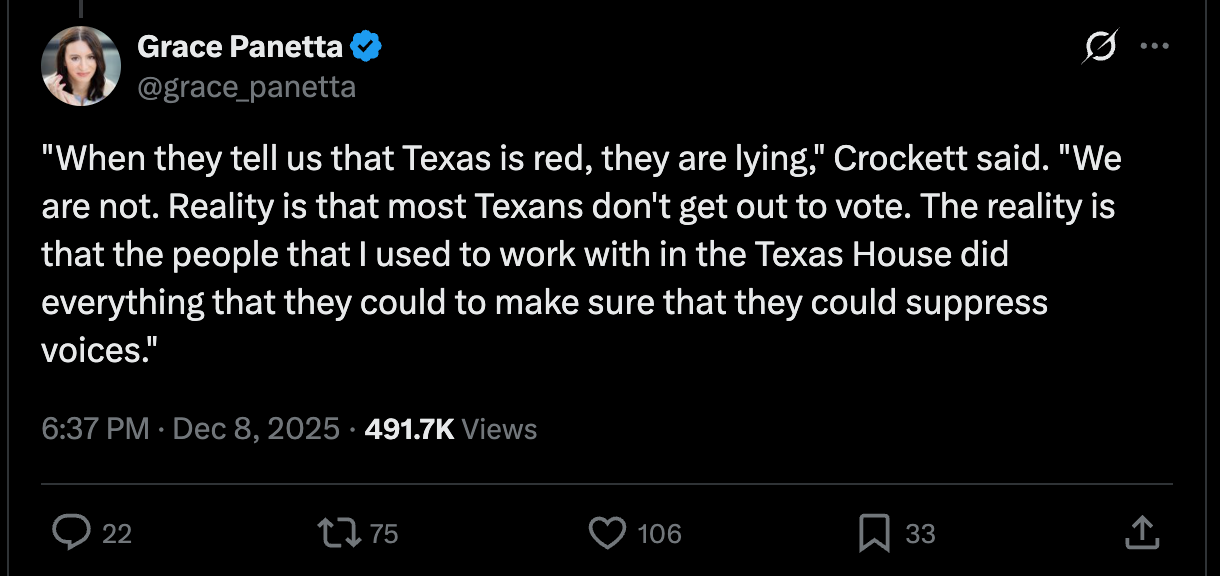
I want to be clear: Jasmine Crockett isn’t the only one to take this line of reasoning, but she’s the most recent, and highly public.
Is Texas a red state?
Yes. Trump won it by 13.7% in 2024, which was *up* from his 9% victory in 2016. Ted Cruz won by 8.5% in 2024. A Democrat hasn’t won statewide office in Texas since 1994. This is, by all metrics, a red state. That’s not like, a dig! I think some people understand calling a state “red” to be derogatory, or a way to write it off. “Red state” is a description of the voting patterns of the state.
Crockett is not the first or only one to say something like this about states not “really” being red. It’s usually deployed as a sort of “we can win, rah rah” thing, and probably the literal truth of it doesn’t matter to most people hearing it. But it’s still wrong.
The logic behind her statement goes like this- there’s enough people in the state (either registered as Democrats, or who might be Democrats if they registered) that if they all voted, they’d outnumber the Republican votes cast last cycle, thus the state is “actually” not a red state.
Friends, this is every state. *Of course* if Democrats voted and Republicans didn’t, Democrats would win! That’s how numbers! Most elections have turnout under 70% of the registered population, and a far lower proportion of the eligible population. That’s a lot of people who didn’t vote. You would have to be losing *so* badly for them to not be numerous enough to technically make up the margin. This does not work in practice.
You can go down a fascinating rabbit hole in academic lit about the thing where election results by geography are relatively stable, even as the voting population fluctuates (I’ve seen estimates of something like 20% churn of the voter rolls each cycle). This is an interesting problem. What *isn’t* interesting is wishcasting about how you’d totally win if loads more people voted for you and not for the other guy.
Dreaming of never changing anything
My general position is that turnout vs persuasion is a false choice. Not only is it always both, but they’re correlated. Do really good persuasion, people like you more, they turn out more. The idea that you can “just” do one or the other is fake. Crockett’s comments are symptomatic of a turnout-only strategy (or at least, the impulse to tell primary voters that you’ll run a turnout-only strategy).
Also, the idea that you can run a campaign in a state like Texas and not even try to win over Republican voters is ridiculous. I know this is primaryslop, but come on. I know you won’t, you know you won’t, why are we playing this game. I’d take a perfectly good non answer about how they’ll see the strength of your vision or whatever over this.
I see the rhetoric of “this isn’t really a red state” as part of a broader mindset that treats Democratic failure to win elections as something imposed by outside forces. It’s not that Democrats need to do anything or change anything- if things were fair/perfect we’d already be winning, and we should fight about that fairness instead. To me, this feels like a very conspiratorial and complicated explanation for election results. The cleaner, more accurate answer is that some people just do not agree with Democrats. Many (not all) of these people can be persuaded! Some of them disagree on vague sketches of ideas they half-heard on tiktok, and can be talked out of that! But they’re real people, with real opinions, and not just pawns of some mystery machine.
It would be convenient if you could win by just shifting around the population of voters like they were checkers. That would be more comfortable than trying to appeal to them- and it plays really well with primary voting Democrats to pretend that absolutely zero compromises have to be made in order to win. It’s also a hideously undemocratic impulse that we should resist.
I don’t know what the perfect way to do persuasion in Texas is. Honestly, I mostly think of it as a state where money goes to be lit on fire. The dream of a blue Texas has been “a couple years away” for many years. This is going to be a good midterm for Democrats (for reasons of thermostatic shifts and also Trump being bad at governing), so we’ve probably got a shot, and there’s some interesting infrastructure work going on that may help. I would love to see it happen. And I am going to be watching as whoever wins the primary pivots to a general election message- I can just about guarantee it will be different from what they started the primary with.